EN
EN

In This Article
- The Real Reason Budget Inflators Fail
- What Plastic Gears Actually Do Under Pressure
- Pure Copper Motor vs. Copper-Clad Aluminum: What Suppliers Won't Tell You
- Side-by-Side: Cheap vs. Sourcing-Grade Inflators
- How to Verify Motor Quality Before You Place an Order
- What This Means for Importers and Distributors
- Conclusion
Every year, thousands of importers place orders for portable tire inflators based on the same three numbers: PSI, price, and MOQ. The units arrive, clear customs, hit the warehouse floor — and within 90 days, the return requests start coming in.
The complaint is almost always the same: "It stopped working." Sometimes after three uses. Sometimes after one flat tire on the side of a highway. The buyer blames the brand. The brand blames the factory. The factory points to the spec sheet, which technically checked out.
The problem was never on the spec sheet. It was inside the motor housing.
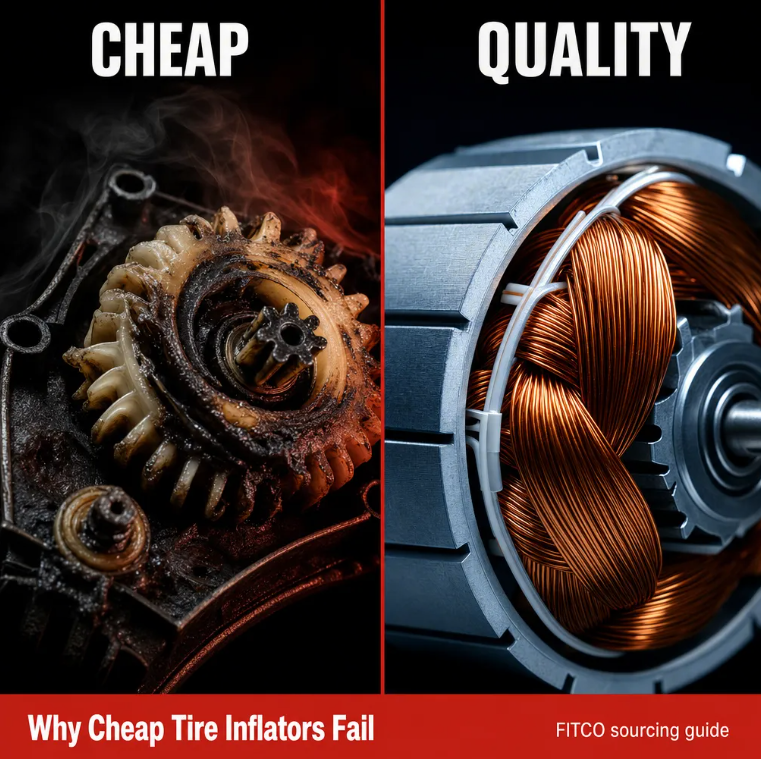
After 10 years of sourcing portable automotive tools for North American and European importers, I've seen this failure pattern repeat itself with predictable consistency. The root cause, almost every time, comes down to two components that no catalog photo will ever show you: the gear material and the motor winding. This article breaks down exactly why cheap tire inflators fail — and how to evaluate these factors before your next sourcing decision.
The Real Reason Budget Inflators Fail
When a tire inflator fails prematurely, buyers typically attribute it to a defective unit or poor overall build quality. Both explanations are vague enough to be useless for sourcing decisions.
The more precise diagnosis: most budget inflators are not engineered for sustained high-pressure operation. They are designed to pass the factory test cycle — usually a 3-minute inflation at moderate pressure — and look good in a product listing photo.
Real-world use is different. A standard 195/65/R15 car tire starting from flat requires continuous operation at pressures climbing from 0 to 35–36 PSI. This is where the thermal and mechanical stress begins to expose the difference between a sourcing-grade unit and a catalog-spec unit.
Two components bear the majority of this stress: the drive gear assembly and the motor windings. Understanding how each fails — and why — gives importers a concrete framework for evaluating suppliers beyond the PDF spec sheet.
What Plastic Gears Actually Do Under Pressure
Gear assemblies in budget-tier inflators are typically made from engineering plastics — most commonly Nylon (PA66) or POM (polyoxymethylene). These materials are chosen because they are cheap to injection-mold, light, and quiet under low load.
Thermal deformation threshold: PA66 Nylon begins to soften at approximately 70°C and reaches its heat deflection temperature at around 90–110°C under load. At 150 PSI — the maximum rated pressure on most mid-range inflators — motor temperatures can routinely exceed 100°C during continuous operation.
At that temperature, a plastic gear under load does not shatter. It deforms slowly. The teeth warp microscopically at first, increasing mesh friction, which generates more heat, which accelerates deformation further. This is the failure cascade that ends with the motor stalling and burning out.
What you actually see as an importer:
- Units that work perfectly during the initial QC test (short cycles, moderate pressure)
- Units that fail after 3–5 uses in real conditions (longer cycles, higher starting resistance)
- Returns clustered around the 30–90 day mark — after the product has reached the end buyer
- Failure descriptions that say "motor stopped" — because the gear deformation caused the motor to stall
| Gear Material | Heat Deflection Temp | Failure Mode Under High PSI | Typical Lifespan |
|---|---|---|---|
| PA66 Nylon | ~90–110°C under load | Tooth deformation → stall → motor burnout | 50–200 cycles |
| POM (Delrin) | ~100–130°C under load | Gradual wear, accelerated under heat | 100–300 cycles |
| Sintered Steel / Zinc Alloy | >800°C | No thermal deformation; normal wear only | 1,000+ cycles |
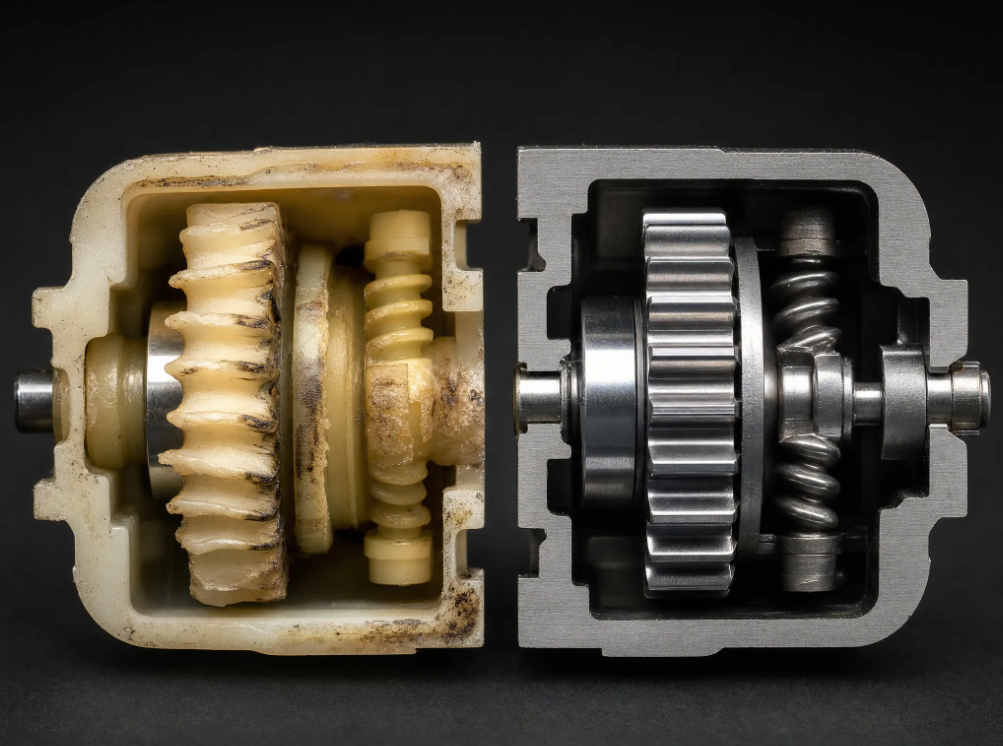
At FITCO, gear material specification is a non-negotiable in our supplier qualification checklist. Every inflator model in our lineup uses sintered steel or zinc alloy gear assemblies — a requirement we verify via sample teardown before any production run is approved. Our durability benchmark is continuous operation at 150 PSI for ≥30 minutes without pressure drop, tested on-site using a pump endurance tester.
Pure Copper Motor vs. Copper-Clad Aluminum: What Suppliers Won't Tell You
Motor winding material is the second major variable — and the one most systematically obscured in supplier communications. You will almost never see on a product spec sheet whether the motor uses pure copper windings, aluminum windings, or copper-clad aluminum (CCA). Suppliers will use the word "copper motor" liberally. What they mean, in many cases, is CCA — an aluminum wire core with a thin copper coating.
Electrical conductivity: Pure copper has a conductivity of approximately 58 MS/m. Aluminum sits at around 35 MS/m — about 60% of copper. Lower conductivity means higher resistance in the windings, which means more energy is converted to heat rather than mechanical output.
Thermal management: Copper has a thermal conductivity of approximately 385 W/m·K. Aluminum is around 205 W/m·K. This means copper windings dissipate heat from the motor core roughly 1.9x faster than aluminum windings — the difference between a motor that maintains stable operation and one that overheats progressively with each use.
Weight as a proxy indicator: Copper has a density of 8.96 g/cm³ versus aluminum's 2.70 g/cm³. A pure copper motor will be noticeably heavier than an aluminum or CCA equivalent for the same coil geometry — typically 150–300g more per unit. This weight difference is one of the fastest on-site verification methods available to importers.
| Property | Pure Copper | Copper-Clad Aluminum (CCA) | Aluminum |
|---|---|---|---|
| Conductivity (MS/m) | ~58 | ~40–45 | ~35 |
| Thermal Conductivity (W/m·K) | ~385 | ~200–220 | ~205 |
| Density (g/cm³) | 8.96 | ~3.6–4.5 | 2.70 |
| Oxidation at connections | Conductive oxide | Insulating oxide (aluminum core) | Insulating oxide |
| Relative motor lifespan | Baseline (100%) | ~85–90% | ~75–85% |
FITCO requires all motor windings to be pure copper and asks suppliers to provide material certificates before sample approval. As a cross-check during incoming inspection, we use a weight comparison method: a motor claiming pure copper windings that comes in more than 10% lighter than the reference weight triggers a re-verification request. This is not infallible, but it catches CCA substitution at the component level before it reaches a production run.
|
Sourcing a tire inflator for your market? FITCO supplies OEM-ready portable inflators with verified metal gear assemblies and pure copper motors. MOQ from 100 pcs. Available for private label and retail-ready packaging. |
VIEW PRODUCT → GET A QUOTE → |
Side-by-Side: Cheap vs. Sourcing-Grade Inflators
Here is how the two product tiers compare across the dimensions that matter most to an importer evaluating a new supplier:
| Evaluation Dimension | Budget-Tier Inflator | Sourcing-Grade Inflator |
|---|---|---|
| Gear assembly material | PA66 Nylon or POM plastic | Sintered steel or zinc alloy |
| Motor winding | Aluminum or CCA | Pure copper |
| Sustained 150 PSI operation | Prone to overheating after 5–8 min | Stable through full inflation cycle |
| Typical return rate (retail) | 8–15% within 90 days | 2–4% within 90 days |
| Unit weight signal | Lighter (aluminum/CCA winding) | Heavier (copper winding) |
| Factory price delta | Baseline | +$2–4 per unit typical |
| Amazon review pattern | "Stopped working after 3 uses" | Complaints about accessories, not motor |
The price delta at the factory level is $2–4 per unit. The cost of one return, including logistics, customer service, and replacement, is typically $15–35 for a retail channel product. The math on which tier is actually cheaper to source is straightforward once the full cost picture is visible.
How to Verify Motor Quality Before You Place an Order
Gear material and motor winding type are almost never declared on a standard spec sheet. Here are the verification methods that work in practice:
|
01 — Weight Test Request pre-production samples and weigh them. A unit claiming pure copper motor windings that comes in significantly lighter than expected is a red flag. Ask the supplier to explain the discrepancy in writing. |
|
02 — Material Certification Request Specifically ask: "Please confirm whether the motor windings are pure copper, CCA, or aluminum, and provide the material certificate." A confident supplier answers directly. Vague responses warrant follow-up. |
|
03 — Gear Assembly Inspection on Sample Request to open the unit during any factory visit or sample evaluation. A metal gear assembly is visibly different from plastic — color, surface finish, and weight are all obvious indicators. If the supplier resists, that is diagnostic information. |
|
04 — Third-Party Inspection with Motor Teardown For orders above 500 units, a pre-shipment inspection that includes a motor teardown on 3–5 random units is a reasonable request. Cost is typically $150–300 per inspection. The value at scale is obvious. |
|
05 — Amazon Review Cross-Reference Many factories supply identical internal configurations to multiple brands. Searching the equivalent model on Amazon and filtering for 1–2 star reviews surfaces patterns. "Motor stopped after two uses," "gear stripped," and "smelled burning" are all consistent with the failure modes described in this article. |
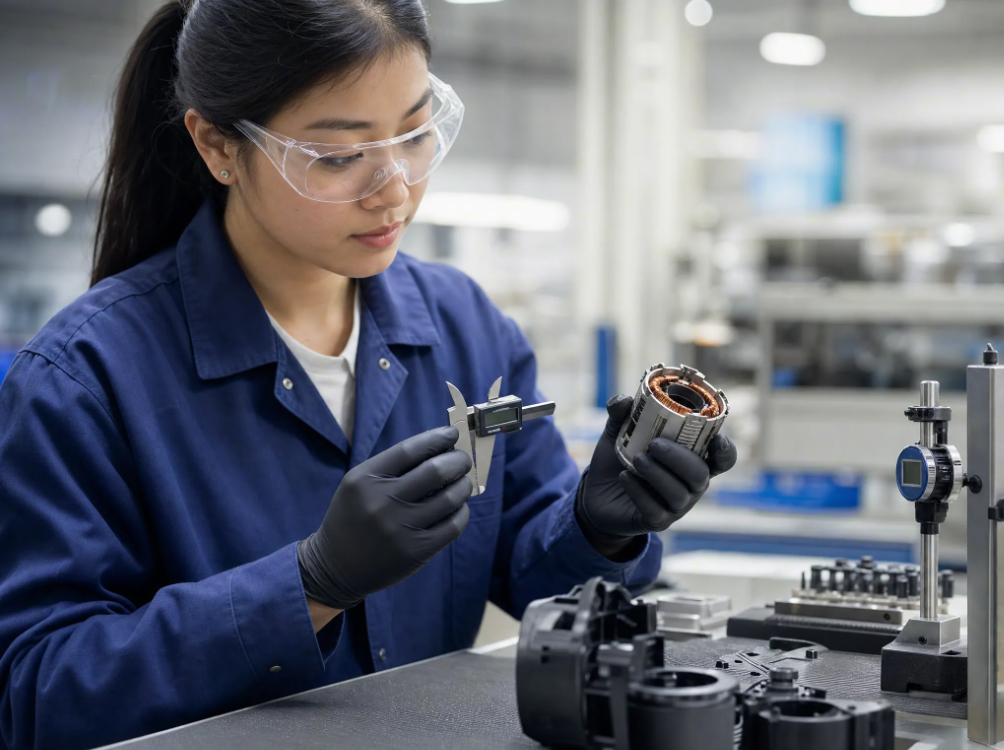
FITCO's QC process follows ANSI/ASQC Z1.4 sampling standards at AQL 2.5 for Critical defects. For buyers who require additional assurance, we welcome third-party inspection agencies (SGS, Bureau Veritas, or buyer-nominated) at any stage of production. Motor teardown inspection on 3–5 random units per production run is available on request.
What This Means for Importers and Distributors
The portable automotive emergency device market in North America and Europe is growing. Consolidation is the driver — buyers want one product that handles multiple roadside scenarios instead of four single-function tools. The competitive pressure this creates has pushed a segment of the market toward price-optimized units that are not engineered for the duty cycles their marketing implies.
The risk: Sourcing on price alone in this category is a false economy. A $3 savings per unit that generates a 10% return rate does not require complex math to evaluate. The reputational cost with downstream retail buyers is often more damaging than the direct logistics cost.
The opportunity: Buyers who have been burned by budget-tier product are actively looking for sourcing partners who can demonstrate — not just claim — product quality. Importers who can provide third-party inspection reports, material certifications, and real-world performance data have a differentiated proposition that justifies a higher FOB price to their own customers.
FITCO works with importers across North America, Western Europe, and Oceania who have made this shift. Our sourcing model is built on verified supply chains anchored in Ningbo, with partners who have supplied automotive tools to US retail chains for over a decade. We do not manufacture — we source, qualify, and manage. That distinction matters when the conversation is about quality accountability rather than just price.
If you are evaluating your current supplier's product quality or looking to switch to a more defensible product tier, the starting point is a sample comparison — not a catalog review.
|
Ready to evaluate a sourcing-grade inflator? Request samples of FITCO's OEM tire inflator lineup. We'll provide material specs, weight data, and third-party inspection documentation on request. |
GET A SAMPLE → VIEW PRODUCT → |
Conclusion
Cheap tire inflators fail for specific, predictable, and preventable reasons. Plastic gear assemblies deform under sustained thermal stress long before they visually appear damaged. Aluminum and CCA motor windings dissipate heat poorly, accumulate resistance at connection points, and shorten operational lifespan in ways that only become visible after the product has left the warehouse.
The $2–4 per unit cost delta between a budget-tier and a sourcing-grade inflator is not a premium — it is an insurance policy against the significantly higher cost of returns, warranty replacements, and lost buyer relationships.
For importers and distributors building a defensible product range, the evaluation framework is straightforward: ask about gear material, ask about motor winding type, request documentation, and weigh the sample. The answers — or the absence of answers — will tell you everything you need to know about the supplier's actual product quality.
If you have questions about evaluating inflator suppliers or want to compare specifications against your current sourcing, feel free to reach out directly.
|
C
|
Charlie Content & Sourcing Specialist · FITCO International Trade (Est. 2016) Charlie manages content strategy, SEO, and B2B marketing for FITCO's independent site and Alibaba operations. With 3+ years in cross-border automotive tool sourcing, she focuses on helping North American and European importers make better-informed product decisions. |
Related reads: FITCO U26021 — 9-in-1 Jump Starter & Tire Inflator | What to Keep in Your Car When Everything Goes Wrong at Once
Table of Contents
- The Real Reason Budget Inflators Fail
- What Plastic Gears Actually Do Under Pressure
- Pure Copper Motor vs. Copper-Clad Aluminum: What Suppliers Won't Tell You
- Side-by-Side: Cheap vs. Sourcing-Grade Inflators
- How to Verify Motor Quality Before You Place an Order
- What This Means for Importers and Distributors
- Conclusion